Showing posts with label Karen Cornelius. Show all posts

Friday, January 2, 2026

Revisiting Memories through Art

A Christmas visit with our daughter, Amanda, ended up with us looking at some of our favorite paintings that reside as copies on our computers.  We also challenged our mental acuity to complete a puzzle we had made from one of Kären's painting.  Wow -- her brushwork! Her visual surprises.  It made me appreciate that painting so much more.  


So given it's the end of the old year, I thought I'd post images of some of the paintings from past years where the back stories we shared with Amanda felt like we were in a time capsule -- and, of course, the puzzle.  In this post I'll stick to representational paintings -- except the puzzle.


Alaska Monolith
Alkyd on panel 12 x 16 inches

During a visit to Alaska's Matanuska Valley, I revisited some of the areas where we spent so many happy hours hiking, skiiing and photographing the joys of living in Alaska.  And yet, somehow, after countless trips into the Hatcher Pass area of the Talkeetna Mountains, I never noticed this peak.  Talk about an artists special abilities to see what so many miss!  Hopefully this painting, based on a photo I took that day, rectifies that problem.


One Last Thing
Acrylic diptych, Each 9x12 inches

Creating Shutterfly calendars during our visit led us to focusing on Kärens photographs of ravens.  Which leads me to include one of my favorite paintings by her, a diptych of a pair of ravens with one of them getting in the last word.  In case you didn't notice, each painting is of the same bird.  Yes, that's one of the advantages painting has over photography.


Along the Cutoff
Alkyd on panel 12 x 16 inches

It was May and yet winter still lingered along the Haines Cutoff between Haines, Alaska and Haines Junction, Yukon.  Ahead of us, as we drove north, a mountain glisteneded like it was coated in ice.  We had to get photos of it.  And then a pullout appeared.  Look closely and you'll see a willow ptarmigan that greeted us when we turned off the highway.


Along the Dempster
Watercolor. 9 x 12 inches

Kären captured this view during one of our very favorite drives -- the Dempster Highway leading from near Dawson City, Yukon, 478 miles (769 km) north to Inuvik, Northwest Territories.  While the route is an artists and photographers dream, it does present several challenges -- a rocky road surface made to shred tires and the further north you drive mosquitoes so thick that when you face into a stiff wind, they take advantage of the shelter you provide and your back look like it's been spray painted with pepper.  But, the views and wildlife -- oh my.


El Cabezone
Alkyd on Canvas  20 x 24 inches

Gazing out our plane's window as we approached Albuquerque, New Mexico, we viewed 
in the distance
 one reason why the southwest holds such mystique -- El Cabezone.  We had to see it up close.  Sure enough, in a couple of days we were bouncing down a dirt road closing in on a trail leading up the volcanic plug.  But, wait, the most artistic view of El Cabezone seemed to be looking up a stream bed we crossed on the way.  So here it is.  For the record, we were able to climb half way up the mountain until it transformed from a hike into a technical climb.


Baird's Retreat
Watercolor  14 x 21 inches

To keep up her teaching certificate, Kären had to take so many hours of continuing education.  And, somehow a class on brown bears qualified.  To meet the course requirements she had to complete either a written paper or a painting.  In true Groth fashion she did both, with the paper including illustrations, plus a separate painting -- each one being completed, in true Kären fashion, on butcher paper -- a surface not considered to be archival.  I was so taken by the painting of Baird Glacier I convinced her to create another version on a surface (watercolor paper) we could have framed and enjoy without watching it deteriorate.


Bessie at the Helm
Watercolor  9 x 13 inches

Kären based this painting on a photograph I took of my kayaking. companion, our golden retriever Bessie, as we kayaked out of LeConte Bay in the USFS Stickine - LeConte Wilderness Area.  After two nights camping 
in the fiord
, the second near the face of LeConte Glacier, a drizzle had descended on us.  So I decided to head back to Petersburg with Bessie pointing the way home -- well maybe would have if she had been awake.  Come to think of it, that night camping close to the glacier is worthy of a blog post because, let's say, it failed to meet the definition of uneventful.


Four on the Point
Alkyd on Canvas. 18x 24 inches

17.5 miles south of Petersburg the only bridge across Blind Slough leads to the Crystal Lake Fish Hatchery. We never fail to stop in the middle of the structure to enjoy the views both up and down the Slough while we try to spot wildlife from bears to swans.  I based this painting on the view further up the Slough where four alders that grow on a point of land jutting into the Slough were backlit by the morning sun and as it's winter coat of ice was relinquishing it's frozen grip 


Tongass Backwater
  
Alkyd on canvas. 18 x 24 inches

In days of yore we had a fleet of watercraft.  A 17-foot fiberglass boat, a 17-foot Klepper kayak and a 17-foot aluminum canoe -- all purchased under different circumstances with no consideration of length.  The day I took the reference photo for this painting a friend and I paddled the canoe upstream from the bridge across Blind slough -- come to think of it -- past the alders in the above painting "Four on the Point."  There we landed at the mouth of a tiny stream that used to drain a large pond created by a beaver dam.  I say "used to" since the beaver are no longer there so neither is the pond.  But, I digress.  I painted "Tongass Backwater" from the mouth of the stream.  For the record the day we discovered the pond was missing, we dragged the canoe around log jams and over all-matter of foot-entangling brush (never finding enough water to float the canoe) only to discover a grassy meadow behind the beaver dam.

And now, (sound the trumpets) Kären's painting that we had made into a puzzle.


Why Snowmen Don't Have Noses
Watercolor  16 x 20 inches

Kären let her imagination run wild as she joyfully painted this rendition of the view from our living room window.  Somehow our local deer herd seems to relish carrots they have stolen from the snowmen while our house has been moved across the street.


And finally, the "Why Snowmen Don't Have Noses" puzzle.  With only  252 pieces it still proved to be a real challenge.


Friday, August 28, 2020

Frontier Justice

In the early 1970s, the Palmer game warden, Fred Smith, occupied the corner office two doors down from where I was stationed as an Alaska Department of Fish and Game game biologist.  Well past retirement age with fleeting eyesight and a receding gray hairline, Fred still made as many cases as the best of them.  


The reason: people identified with this friendly grandfatherly gentleman.  Fred didn't have to sneak through dense willow thickets to pounce on poachers.  Everyday citizens, fed up with seeing someone else steal their moose or salmon dinner, simply reported violations to Fred.  He excelled at being a kind old man telling stories about the good old days.  The public reciprocated with modern day versions.  


My opportunity to assist Fred came the night I registered for a mid-winter watercolor painting class.  Returning home that frigid night on the winding remote (at that time) Matanuska Valley roads, a parked car seemed out-of-place.  Strange, I thought, so slowed to read its license plate number.  The notion that something didn't seem right gnawed at me until back home, I turned around and drove back.


The car had disappeared.  Instead I found blood in the road.  Armed with a flashlight, my boots squeaking in the cold, I followed a trail of crimson flecked snow to a steaming moose gut pile.   Back home I dialed Fred.  


Fred said he would check on the license number.  A few minutes later my phone rang.  It was Fred.  Rumor had it the owner of the car whom I shall call "Robert" was a moose poacher who sold the meat to the poor.  Fred still hadn't been able to make a case against this supposed modern-day Robin Hood.  He said Robert would be at the Pioneer Cafe the next morning.  I should meet him there.


At 7:30 AM, sure enough, I found Fred standing in the Pioneer Cafe parking lot next to the drab weathered sedan I had seen the previous evening.  The key to the trunk remained fixed in place, obviously ready for quick action.  Fred twisted the key.  The trunk popped open to reveal a blood-stained interior and moose hair, not the typical trunk used to transport suitcases to the airport.  Fred directed me to collect a blood sample on a microscope slide and close the lid saying he'd be right back.  I complied then dashed inside not wanting to miss the action.


Inside the Pioneer Cafe Fred found a tall angular man clad in Army surplus "bunny boots" wearing a grease-stained parka right where he knew he'd find him, sitting at a counter stool in front of a plateful of bacon and eggs.  


Fred approached Robert and with a friendly smile, simply said, "When you're done, come on over to my office," and left.  That was all.  That's sure not how they do it on TV, I thought to myself.


Fred and I went back to our respective Fish and Game offices and waited.  It didn't take long before I saw Robert slouch past my door.  I listened intently.


"You never know when your friends are going to rat on you," I heard Fred say.


"Who told you?," a panicked Robert replied.  "Who was it?"


Of course Fred was only making up a story, but that sounded like a confession to me. 


After more unsuccessful pleading from Robert about how Fred knew,  I heard Fred state, "we need to go get the meat, it would be unlawful to leave it where it was."


I couldn't believe what I was hearing.  "Unlawful."  Since when did that bother Robert?  However, he fell for Fred's bluff and with that the two of them got up and Robert led Fred to the evidence -- the evidence Fred needed to make his case, a case for which Robert spent six months in jail. 


Today I muse at the chances.  My love of art led me down that road.  I had been disappointed that all we did was register for the watercolor painting class, receive our materials list and an announcement the class would begin the following week.  Feeling let down, I drove home hours earlier than expected that evening.  Later, when class would normally have ended, Robert would have vanished and, at best, I might have seen blood on the snow-covered pavement. 


Otherwise, a flock of ravens, maybe a pair of eagles at the top of a cottonwood tree would have alerted us that another moose had been poached.  Why didn't we ever catch these guys?  Chances -- chances and a bit of bluff from a kind old man broke the familiar pattern leading, for once, to frontier justice.


        Dance of the Aspens  9 x 12 inches  Alkyd on Canvas  Private Collection

Other than a whimsical watercolor card, this is the only painting I have which includes a moose,  Thus, wanting a moose painting for this post, it'll have to do.  I started Dance of the Aspens as a plein air piece in the Yukon.  There I was drawn to the aspens battered by wind and snow to take on every manner of twisted shapes.  I didn't complete the painting that day, so brought it home to finish in my studio.  As for the moose, she's an add on from a photo Karen took in a similar area Fred would have patrolled although, given his poor eyesight, probably never would have seen.  In fact, neither did I.  But, Karen did.


Friday, December 30, 2016

Winter Harbor II Colors

Sometimes Karen comes home with photos having the strangest backgrounds — reflections of whatever lays beyond her subject — especially when she’s aiming her camera towards water.  Normally, this isn’t a problem in wildlife photography — unless you’re photographing a raven sitting on a green dumpster or you find some inconsiderate person’s beer can in the image’s background when you download it onto your computer.  


                              Petersburg's South Harbor offers a wealth of background colors.

The difference is — Petersburg’s harbors in no way resemble nature.  Here you find boats, mostly commercial fishing vessels, painted in a wide array of colors — from a somewhat menacing black to first-responder red to electric blue, even rust.  Should I include a pea soup-green fish-processing cannery?  Here, they turn reflections across the harbor’s water into a myriad of colors — definitely not something natural.

Now float a bird or even seal amidst those colors and viola, you have the most surreal wildlife photo.  In other instances our low-angle winter sun, maybe blazing onto a snow-covered mountain, or even our rare blue skies expand that varied palette reflecting off the water.  Add the ripple of waves and you have your subject resting in an abstract painting.


                                 A male Barrow's Goldeneye in the most unreal setting.

Of course Karen did not set out to capture unreal images.  The birds decided where she would photograph them, but you can be sure few of these images would make the cut in a photo book of Alaskan birds.  


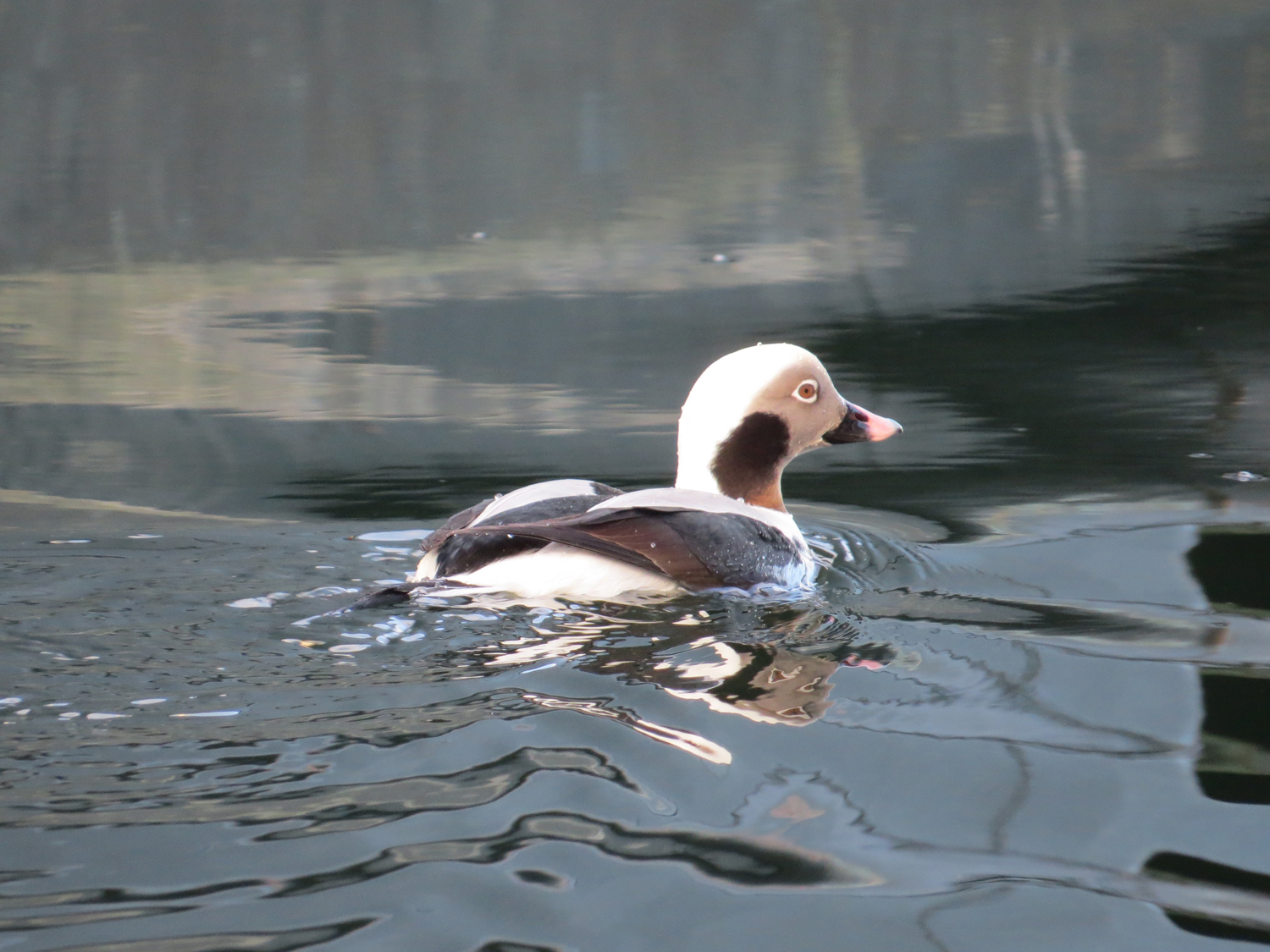
Is this long-tailed duck (formerly known as oldsquaw until the group of poobahs who name birds decided to change it) backed by a boat or sky reflections?

And since I’m not good at resisting temptation, why not include a couple of  Karen’s photos of birds that, in themselves, provide an unreal level of color.  While the females of most waterfowl species are well camouflaged, this is certainly not the case with the males.  Since their role in propagating the species is limited to looking pretty for the “girls” — a couple of moments to pass on their genes, and poof, think I’ll pass on the parenting responsibilities — perhaps they’re more expendable.  It certainly seems a brightly colored mallard drake would be an easier target for a hungry predator than his camo-clad mate.

So here some of Karen’s latest colorful winter harbor creations.


                          Guess there's no question where Karen found this male long-tailed duck


   Low-angle sun shinning through morning fog created an atmospheric background for this bufflehead.


                           It looks like a bit of a mix of background colors for this pair of greater scaup.


                                         A another pair -- this time Barrow's goldeneyes.


         Two males, a surf scoter and a Barrow's goldeneye, emerge out of a sunlit foggy background


                       These barnacle-clad piling don't even need a bird to be appealing.


                                                         Then again, this great-blue heron helps

                It looks like blue sky for this surf scoter, but how can it hide with a bill like that.

                                       What lady duck could resist this American wigeon?


This mallard drake shows the trade off -- attract the "ladies" or predators.  Judging at how successful mallards are, it looks like the "ladies" win.

                       Then again put them in this harbor reflection and does it even matter?

Oh, bet you thought I forgot the raven.  Karen just zeroed in on a head shot.  Viola, no dumpster.  Now we're not sure about the white flecks on it.  We hope it hadn't been roosting below a pigeon. 


Monday, December 26, 2016

Winter Harbor Part I

Here in this corner of Alaska mid-December blessed us with an abnormal stretch of clear cold weather.   Combine that with Petersburg’s setting — one bounded by harbors that boats share with overwintering waterfowl and you have the recipe for a smile on Karen’s face despite cold hands and toes.  Multiple species of waterfowl that could be far to the south basking along sunny beaches dodging sunscreen slathered tourists, short circuit their migrations to remain here where they add color and life to our little burg.


At first glance, Petersburg's boat harbors look like they could have been taken anywhere in America -- er, make that Alaska.

Of course Karen has been making daily forays to commune with the harbor denizens with her camera.   And each day she brings back photographic treasures that are impossible to top -- until the next day.  While further south in wildlife refuges, and other areas popular with bird enthusiasts, she’d be shoulder to shoulder with camo-clad photographers vying for the best position, here Karen has the critters virtually all to herself — unless someone’s black Labrador retriever comes over to nuzzle her derrière while she’s zeroing in on a rare species she’s been stalking for half an hour.  Of course!  She might toss a stick.

OK, there are a set of different challenges for Karen, but she certainly rises to meet them.  Now she’s suggesting she would like to carry dog biscuits for her four-footed friends.  I’m not sure carrying such contraband would enhance her photographic efforts regarding the wild side of Petersburg.  But, then Karen is not your everyday wildlife photographer.  She seems just as happy to bring home images of the domestic citizens too.


Actually both four-footed and two-footed friends can render an impressive stalk into an everyday scene around Petersburg.

Naturally Karen has been so productive that it is hard to include as many images as we would like in a single post. Thus, we'll break this one up into several installments. 

                      Barrow's goldeneye are a common resident in Petersburg's harbors.

Mallard drakes, so wary in areas frequented by waterfowl hunters find Karen about as threatening as a snowflake.

                        Three male surf scoters also consider Karen to be just part of the scenery.

For Karen common loons were one of the favorite parts of the north woods where she spent her childhood summers.  Now those north woods are down south in Wisconsin and the loon in winter plumage fails to match her childhood image.

 A female common merganser appears to have visited a local beauty salon.  Then again, with a natural coiffure like this, she didn't need to.  


                               A comparatively tiny female bufflehead paddles past Karen...

                                           And through a flock of snoozing mallards.

Karen was very excited to hear a hooded merganser was frequenting our harbor.  The sight of it didn't disappoint her.

 A great-blue heron looks like a grumpy old bird as it rests on one of the harbor floats.  This is the same species Karen has photographed in other pacific northwest states and, if she ventured all the way to Florida, she would likely still be aiming her camera at one.

                         Frost-covered grass kept distracting Karen, so she added it to her collection. 

This is but a sample of images Karen captured this month.  We plan to publish more very soon.  Oh, and about the cold toes.  It seems that when some footwear gets too cold it....EXPLODES.


                     Maybe that Salvation Army thrift store pair of boots was not such a bargain after all.

Thursday, October 22, 2015

Life on the Docks

Winter in coastal Alaska has a bonus not enjoyed by someone living in — say — Delmar, New York (where I finished high school) or Brookfield, Wisconsin (where Karen grew up).  Like grizzled retirees from those same towns chasing the winter sun, waterfowl and shorebirds, fleeing iced-over ponds and marshes in interior portions of the continent, sashay down to our coast.  Here they happily spend the darkest months indulging in fresh seafood delicacies that dwell in our marine waters.  They join larger members of the animal kingdom whose “wings” just aren’t powerful enough to enable them to fly — except through the water.

                            A pair of Common Loons newly arrived after interior lakes began to freeze over


Barely more agile on land than a bowling ball and even less so in the air, this Harbor Seals epitomizes grace when it "flies" through the water.

This is particularly true at the northern end of Wrangell Narrows, the site of the city of Petersburg, where harbor seals and Steller’s sea lions are joined by thousands of gulls, ducks and shorebirds.  Here upwelling seawater nourishes an ecosystem filled with enough species of marine worms (yum) and fish to keep “everyone” happy with the added bonus of tasty ground-up seafood processing waste from our local canneries.  


A Common Loon wrecks the day of a fish -- but can it swallow that big of a victim without a set of wolf-like choppers?

                                                                     No Problem!  Well, maybe just a little.

For the record, one local cannery’s permit required wastes to be discharged in waters somewhere around 30 or 40 feet below sea level.  Wellllllll…..I once joined inspectors diving on that outfall.  While we navigated to the site, the diver made his final preparations.  Oxygen tanks filled— check.  Dry suit on— check.  Regulator functioning — check.  Tank valve open — check.  A couple of test breaths — check.  Weights on — Check.  Get ready, we’re closing in.  STOP!  REVERSE ENGINE!  WATCH OUT!  DON'T HIT THE PIPE!  If he had jumped over the side of the boat at a deep spot he might have gotten his knees wet.

I never saw the final inspection report.  However, I couldn’t help but notice that currents are so fast at the site that the discharge is well diluted.  Instead of looking like a biological wasteland around the outfall — as sterile as Mars but less colorful — the area looked more like a Hawaiian coral reef.  It’s a great place to cast a fishing lure during higher tide levels.

This week Karen took her new Canon Powershot SX50 camera out on the docks to give it another test run.  The first day, as she slowly crept up on several sleeping seal lions, she paused.  “Why do I have this uneasy feeling?”  The dock began rocking and bobbing accompanied by the increasing volume of a gurgling sound.  Suddenly a geyser of water reminiscent of Yellowstone’s Old Faithful erupted as it gushed out of a standing pipe -- the one under which she was hiding.  Karen had been creeping from pipe to pipe using them as photographic blinds — if one can use a standing pipe as camouflage.  Only Karen would take a shower on the docks — without a towel.  Most others seek out more private facilities.


Nevertheless, brave Karen returned the next day, this time using her navigational skills to avoid that “trap.”  She went to a different dock.

                                                 Steller's Sea Lions know the meaning of comfort.

                                           So who's keeping track of whose flippers belong to who?


            Black Turnstones and Surfbirds seem to sense that Karen is a softy when it comes to predatory instincts.

Petersburg's upside down Harbor Seal cruises through the harbors in it's own style.  Don't knock it until you've tried it.

                                                                           It's downright addictive.

A short-billed Dowitcher proved a challenge in deciding if it was the short-billed species or the long-billed version.  Here's hoping we got it right.  The surfbird was an easy call.

This Bonapartes Gull is unlikely to stick around all winter, but will be another harbinger of spring in five or six months.  Just the thought of that makes us think it's on to something.

                                             You know, there's more than one way to fly.  I wonder......